
Why flexibility needs intent — and how flex spaces can get it right
The idea of the flexible workplace has evolved rapidly over the last few years. What began as a response to hybrid work and fluctuating attendance has now become a defining feature of modern offices and flex environments.
Yet, as recent global workplace thinking highlights, flexibility alone does not guarantee effectiveness. Many flexible workplaces underperform — not because they lack adaptability, but because flexibility is implemented without intent. For flex space operators in India, this distinction is critical.
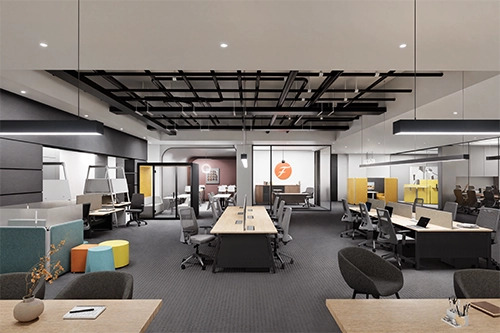
Products Featured – Synergy & Perform Workstation, Genesis Recharge, Amaze Chair, Pouffes by Featherlite
Flexibility is no longer the differentiator — execution is.
Global research, including insights discussed by Work Design, shows that work behaviours have evolved faster than workplaces themselves. People increasingly come to the workplace for collaboration, connection, learning, and culture — while deep focus work often happens elsewhere.
This shift changes how flex environments are judged. Success is no longer measured by desk counts or density, but by how well a space supports multiple work modes across a single day
People first: designing for behaviour, not furniture
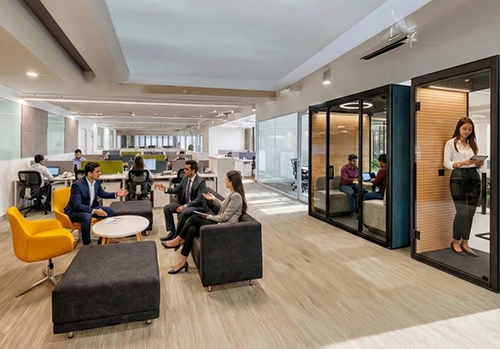
Spaces shaped by behaviour, offering choice across collaboration, focus, and privacy.
Products Featured – Hüssh! Pods, Costa Lounge Chairs, Interact Sofa by Featherlite
One of the strongest lessons from contemporary workplace design is that flexibility must start with human behaviour. Introducing mobile furniture without understanding how people actually work often reduces impact rather than increasing it.
People don’t come to a flex workspace looking for a desk. They come looking for choice — a place to focus, a place to collaborate, a place to take a call, and a place to reset. Well-designed spaces make these choices intuitive.
Place matters more than square footage
Workplaces should be treated as destinations, not neutral containers. Different activities behave very differently — brainstorming thrives on openness, stand-up meetings benefit from upright postures, and focused work requires control.
When these activities blur without intent, utilisation drops even when occupancy appears high. Purpose-driven zoning — enabled by movable screens, high tables, and mobile collaboration tools — allows flexibility without chaos.
Privacy is not the enemy of openness
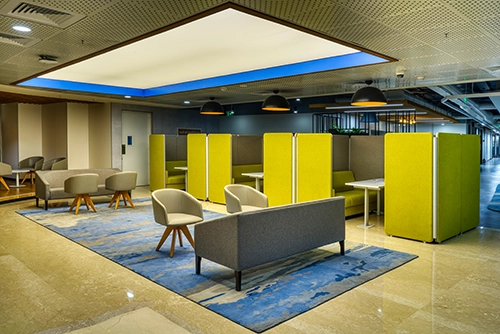
Spaces that let people step away, concentrate, and return — without disconnecting from the workplace.
Products Featured – Genesis Pods, Clara Lounge Chairs by Featherlite.
As collaboration increases, so does the need for privacy on demand. Open environments often remove the very spaces people need for calls, focus, and sensitive conversations. Lightweight solutions such as acoustic phone booths and meeting pods provide enclosure without permanence, allowing users to step away briefly without disrupting the larger workplace.
Community happens in the spaces between
People increasingly come to workplaces for experience rather than obligation. Informal lounges, breakout corners, and social seating quietly shape culture and connection far more than formal meeting rooms.
When these spaces are designed intentionally, they become the most active parts of a flex environment.
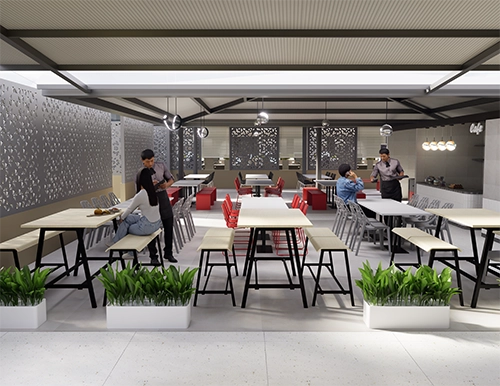
Informal, shared spaces where conversations start naturally — and workplace culture quietly takes shape.
Products Featured – Switch High Tables, Lucas Table, Tang Chair, Leaf Chair & Metal Bench by Featherlite.
Can this space support multiple work behaviours in a single day — without friction?
If the answer is yes, flexibility has been designed with intent. If not, mobility alone will not fix it.
At Featherlite, we believe the future of flex workspaces in India will be defined not by how flexible they look, but by how intuitively they work. When people, place, and purpose align, flexibility stops being a feature and becomes a competitive advantage.
