
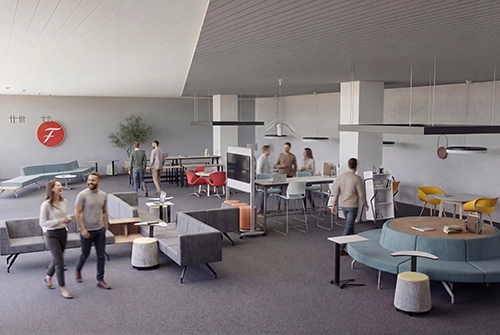
Most workspace redesigns fail before the first chair arrives. Not because of bad taste or a tight budget but because they design for appearance instead of behaviour. They optimize for the tour, not the Tuesday.
Proximity Beats Prestige
Does your workspace have more than one place where people can have an unplanned five-minute conversation? If the answer is “not really,” that’s worth fixing because spontaneous interaction is where most real collaboration happens.The instinct has always been to invest in one impressive centrepiece: a grand cafeteria, a showcase lounge, a rooftop terrace. These spaces photograph beautifully. They also tend to sit empty.
What actually drives engagement is proximity. Smaller, distributed interaction points conversation corners, informal seating clusters, compact work cafes placed throughout the floor plate rather than concentrated in one zone, get used far more consistently. The result is higher engagement, stronger belonging, and more organic teamwork without increasing footprint or cost.
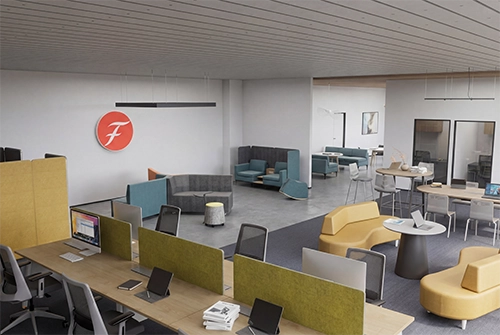
Products Featured – Synergy Workstation, Omega Sofa, Reflex Sofa, Bean Sofa, Dual High Table & S Series sofa
Featherlite insight:
Compact sofas, flexible tables, mobile soft seating, and modular lounge elements allow designers to create multiple “micro-destinations” across a floor plate each one a reason for people to move, pause, and connect
Design for Your Organizational DNA, Not Design Trends
Here’s a test: take the most talked-about workspace feature from the last five years the gaming room, the meditation pod, the artisanal coffee bar -and ask whether it actually gets used in your workspace. In many cases, it doesn’t.The reason isn’t the feature. It’s the fit. A gaming table succeeds in a young, community-driven tech team and collects dust in a structured financial services firm. An informal cafe zone thrives where leadership culture encourages it and sits ignored where hierarchy runs deep.
The most important lesson heading into 2026 is this: not all organizations work the same way, and their workspaces shouldn’t either. Some organizations are process-driven and structured. Others are community-led, innovation-focused, or client-centric. Each has its own rituals, rhythms, and patterns of interaction. When space design aligns with these behaviours, workspaces feel alive. When it doesn’t, even the best amenities sit unused.
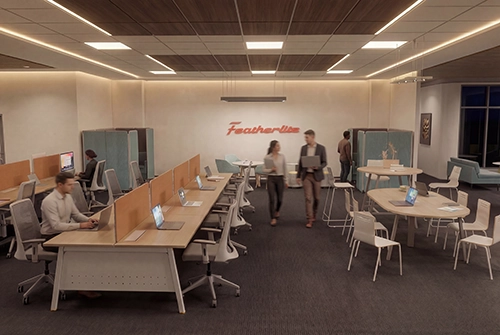
Products Featured – Synergy Workstation, Dual Height Table, Genesis Pods, Amaze & Zella Chairs.
Featherlite insight:
Furniture planning must begin with understanding how teams actually work not how workplaces are “supposed” to look.
Adaptability Is the New Permanence
A major BFSI firm in Pune recently found itself with a floor designed for 120 people needing to absorb a 60-person acquisition team on six weeks’ notice. The result was a chaotic reconfiguration that disrupted both teams for months. The problem wasn’t the growth. It was the rigidity.Leadership uncertainty is not going away. Headcount may grow but which team? Functions may shift but when? Business priorities may change but how fast? Many workspaces are optimized for Day One. Six months later, a restructuring or expansion makes the space inefficient overnight.
The answer in 2026 is what designers are calling the “LEGO spaces” approach: instead of fixed-use zones, allocate a meaningful portion of the workspace to multifunctional spaces that serve different purposes across the day, and convertible zones that can absorb workstations or collaboration setups with minimal reconfiguration. This allows workspaces to scale, shrink, or rebalance without construction or disruption.
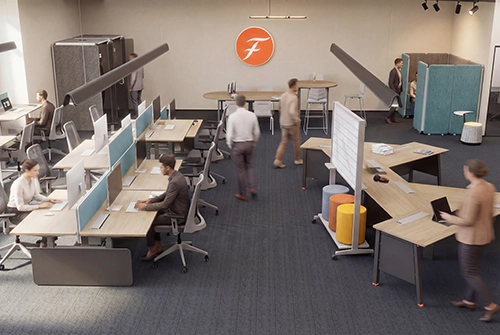
Products Featured – HAT workstation, Synergy Workstation, Nomad, Dual High Table & Amaze Chairs
Featherlite insight:
Modular furniture systems, reconfigurable tables, mobile screens, and plug-and-play seating enable this flexibility far more effectively than fixed built-ins. Products like the HAT Workstation, Synergy Workstation, and Nomad range are built around this principle.
3. India Is Not a Secondary Location
Bangalore is not a back-workspace. Neither is Hyderabad, Pune, or Chennai. For many global organizations, these cities now house their largest teams, their most critical operations, and a growing share of their leadership. The old assumption headquarters get premium design; regional workspaces get efficiency is not just outdated. It’s a retention risk.Leading organizations are responding by investing in world-class workplaces in India, expressed through local culture, materials, narratives, and ergonomics. Global design standards remain consistent, but the expression becomes locally meaningful.
One often-overlooked factor is ergonomic localization right-sizing furniture dimensions, aisle widths, and seating ergonomics to suit local workforce proportions. Done well, this improves comfort, space efficiency, and project economics simultaneously.
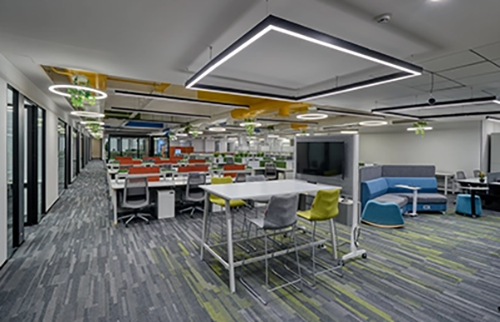
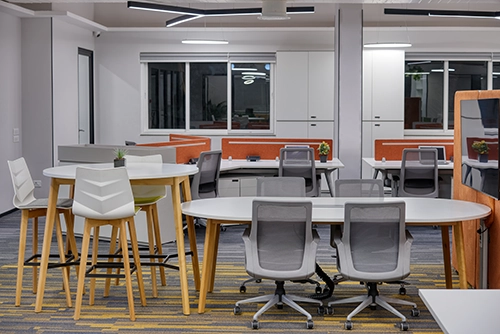
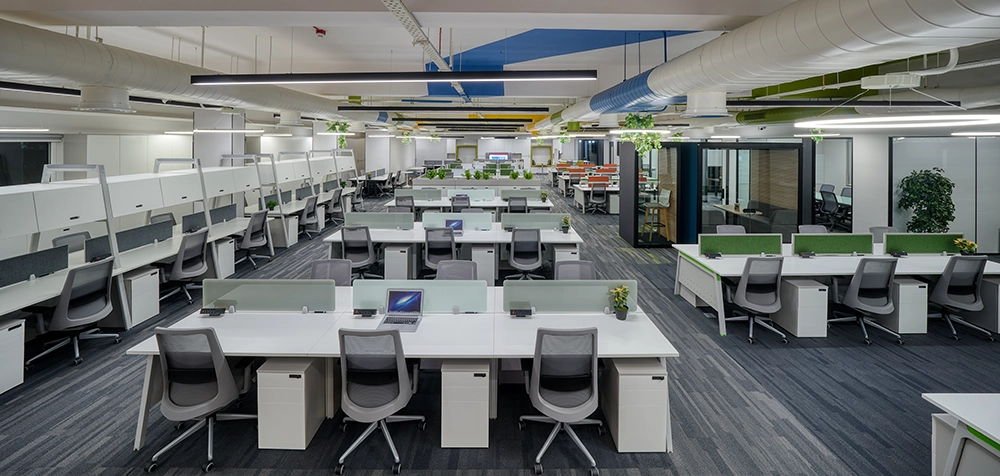
Featherlite Head Office, Bengaluru
Featherlite insight:
As an Indian manufacturer with global design sensibilities, Featherlite is uniquely positioned to bridge
this gap delivering international quality with locally optimized ergonomics and configurations.
5. The Workplace of 2026: A Convergence, not a Checklist
The organizations getting workplace design right in 2026 aren’t doing something exotic. They’re doing something disciplined: they’re weaving together things that used to be treated as trade-offs.- Global design standards with local cultural expression
- Structured workstations alongside adaptive, reconfigurable zones
- Spaces designed around organizational behaviour, not industry trends
- Built-in adaptability that lets the space evolve without renovation
What to measure in 2026
The workplaces that will win are not the ones with the most impressive amenities. They will be measured by four things:- Activation – are people actually using the space?
- Belonging – does the space reflect who we are?
- Adaptability – can it absorb change without a redesign?
- Real work support – does it make the actual job easier?
At Featherlite, we believe the future of workplace design lies in asking better questions about people, culture, and change and designing furniture systems that respond intelligently to those answers.
