
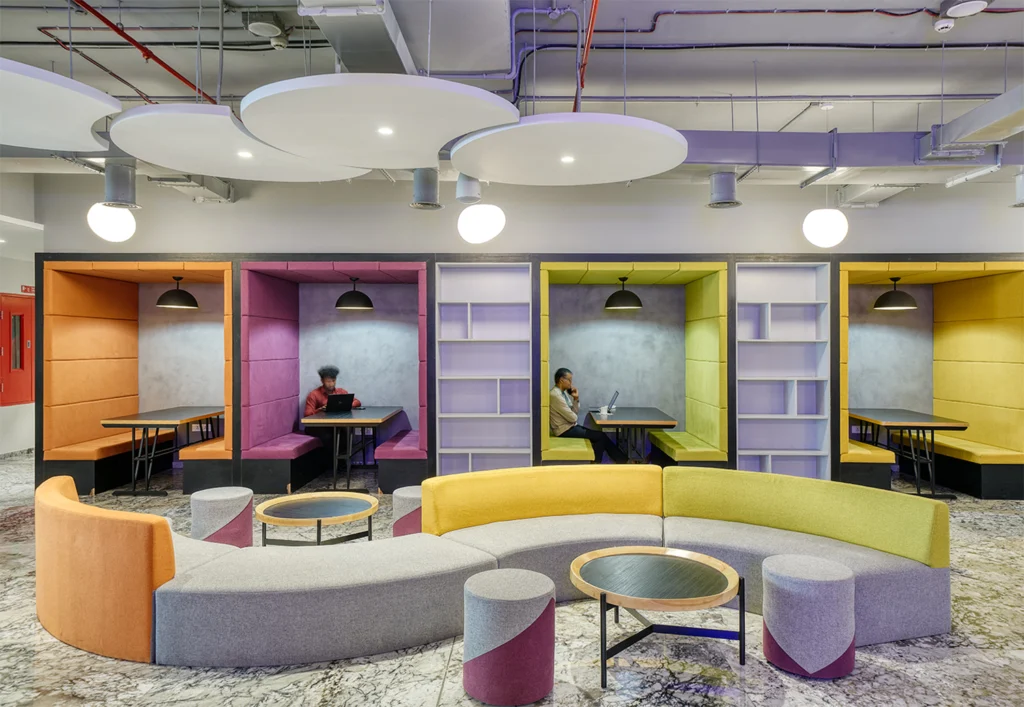
As we enter 2026, the mandate has changed. The new question, driven by data from global leaders like JLL and Thompson Harrison (TH), is far more complex: How well does your workplace facilitate social health?
At Featherlite, we are seeing a pivot in what defines a “high-performance” Indian office. It is no longer about the number of seats; it is about the density of networks. Here is how the “Social-Spatial” revolution changes the game for architects, FMs, and corporate leaders.
Research breaks this down into six measurable elements. For architects and designers, these are the new “functional requirements” for any layout:
- Connection: Do sightlines and pathways encourage spontaneous “collisions”?
- Belonging: Does the space have inclusive zones where every personality type feels welcome?
- Value: Does the furniture signal to the employee that they are valued?
- Purpose: Are there “ritual spaces” (town hall zones, project war rooms) that physically manifest the company’s mission?
- Culture: Is the brand vibe visible, or is it just a sea of grey workstations?
- Learning: Does the layout allow for mentorship via “side-by-side” seating rather than isolated cubicles?
New KPI for FMs: From “Efficiency” to “Network Density“
For Facility and Property Managers, this shift requires a change in metrics. Traditionally, we optimized for Efficiency (Headcount ÷ Sq. Ft.). In 2026, we must optimize for Network Density (Interactions ÷ Sq. Ft.).
A floor plan might be “efficient” because it fits 100 people in rows. But if those 100 people never speak to anyone outside their immediate neighbours, the “Network Density” is low, and innovation suffers.
The Featherlite Strategy:
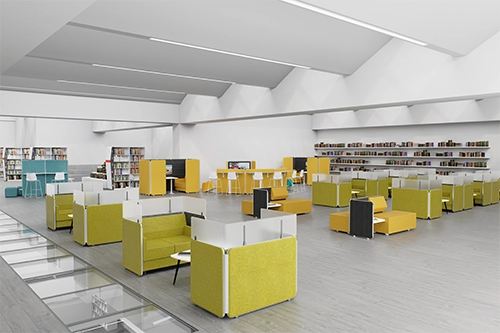
We recommend breaking the “sea of desks” with Social Nodes—centralized active zones equipped with modular lounge systems. These nodes act as gravity points, pulling people from different departments together.
The Indian Context: Breaking Hierarchies & The “Return on Commute”
India’s unique work culture makes this transition even more critical.
- Flattening the Hierarchy
Indian offices have traditionally been status-driven. The new “Social-Spatial” design democratizes the workspace. When a Director and a Junior Analyst both use the same acoustic pod or grab coffee at the same community table, barriers break down. Furniture becomes a tool for culture change.
- The “Return on Commute” (RoC)
In cities like Bengaluru, Mumbai, and Gurugram, the commute is a significant pain point. If an employee travels 90 minutes to sit in a cubicle they could have replicated at home, the office has failed.
The office must offer what the home cannot: High-fidelity human connection.
The Hüssh! Pod
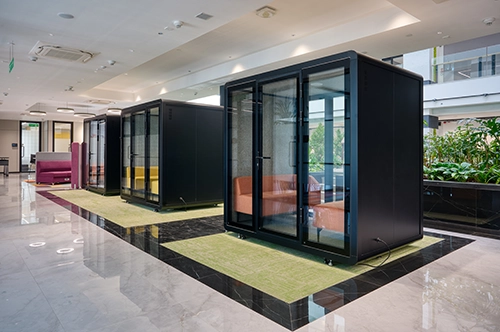
Private. Quiet. Focused.
High-performance acoustic pods designed for the open office.
Designing the “In-Between” Spaces
The magic doesn’t happen in the boardroom; it happens in the transition zones.
* The “Library” Zone: For deep focus, free from the noise of the open floor.
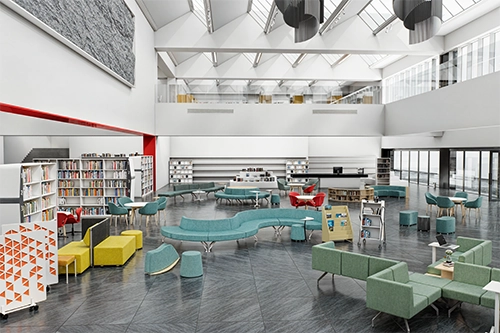
* The “Plaza” Zone: High-traffic areas activated with agile seating like our Collaborate Series to capture energy and encourage quick chats.
* The “Neighbourhood” Zone: Instead of assigned desks, create team neighbourhoods with a mix of sit-stand desks and huddle tables.
Conclusion: A Strategic Asset, Not Just a Cost Center
For our corporate clients and property managers, the message is clear: Furniture is not just CapEx; it is a strategic lever for organizational health.
By aligning your real estate strategy with the principles of Social Health, you aren’t just filling a building. You are engineering a more connected, innovative, and resilient workforce.
Is your office ready for 2026?
Explore Featherlite’s Collaborative Collection
