
Why the next generation of workplaces will manage sound, rather than try to eliminate it.
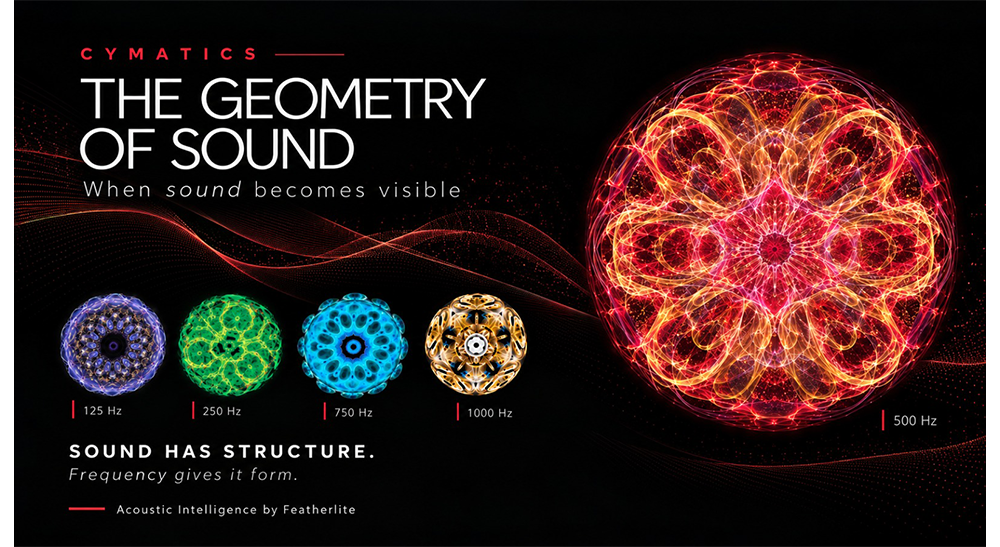
Sound is invisible. But when sound acts on a physical medium, different frequencies can create different patterns. This phenomenon — cymatics — gives us a useful visual metaphor for the workplace: sound has structure.
For years, the conversation around office acoustics has started with the same complaint: “It’s too noisy.” And the instinctive response has been to make the workplace quieter.
The objective of a good workplace should not be silence.
Workplaces are meant to have sound. People talk. Teams discuss. Phones ring. Ideas are exchanged. Meetings happen. These are not necessarily signs of a badly designed office. They are signs of people working together.
The problem begins when sound from one activity becomes noise for another.
The Modern Office Has Changed
Rows of enclosed offices and high cubicles have increasingly given way to open, flexible environments intended to encourage communication and collaboration. Hybrid work has accelerated that change.
For many people, the office is increasingly a destination for teamwork, mentoring, meetings, innovation, social interaction and connection. And that creates an interesting contradiction: the very activities that bring people together also create sound.
One person is on a video call. Two colleagues are having an informal discussion. A project team is collaborating around a table. Someone else is trying to concentrate. Another employee is discussing something confidential with a client.
None of these activities is unreasonable. The acoustic problem occurs because they are happening within the same sound environment.
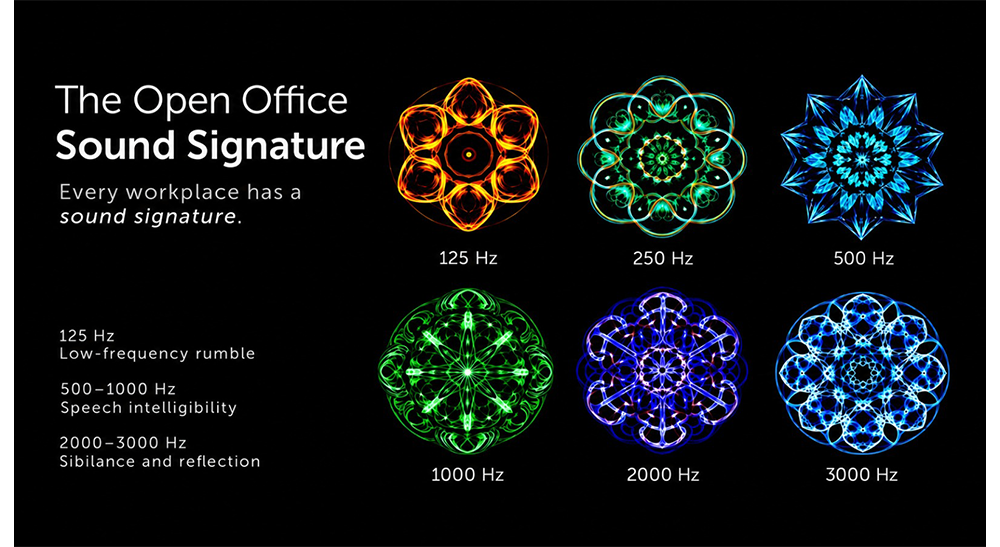
The challenge is not whether offices should encourage collaboration. It is how collaboration and concentration can coexist.
Sound Is No Longer Just a Comfort Issue
When conversations travel freely across an office, concentration becomes harder. When background noise enters video calls, communication suffers. When sensitive discussions can be overheard, privacy suffers. Repeatedly filtering irrelevant speech and sound can also become tiring.
The ABCD of Workplace Acoustics
Sound travels. It reflects. It is absorbed. It moves around obstacles and reverberates. So workplace acoustics cannot be solved simply by putting an acoustic material somewhere in the office.
A useful way to think about managing sound is through four actions:
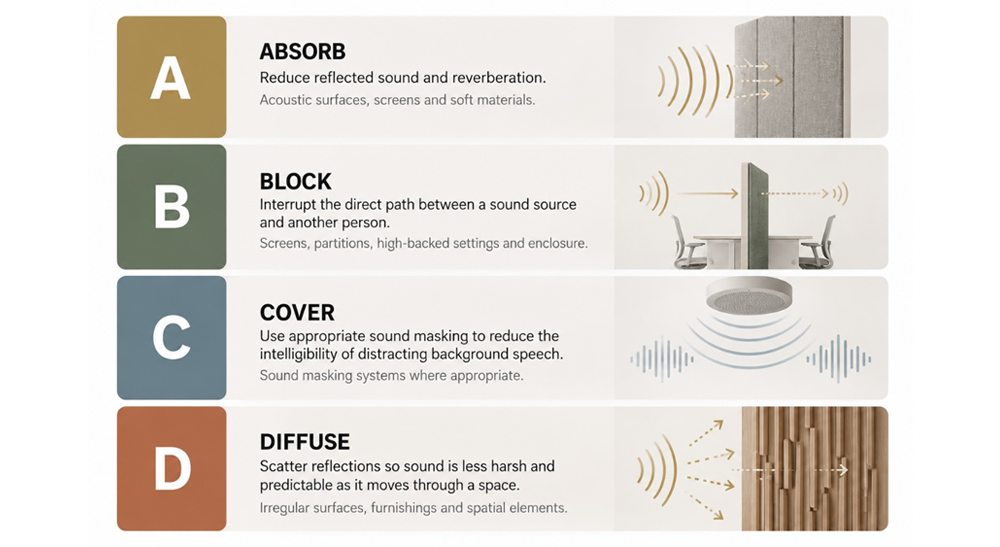
ABCD is not a product specification. It is a way of thinking about how sound behaves.
No single letter solves the workplace. Absorption without zoning may still leave speech travelling directly between people. Blocking without absorption can create reflections. Masking cannot replace genuine privacy. Diffusion alone cannot isolate a confidential conversation.
The value of ABCD is in combination: what needs to be absorbed, what needs to be interrupted, what can appropriately be masked, and what should be diffused.
That changes the conversation from “What acoustic product should we put here?” to “What acoustic condition does this activity actually need?”
It Isn’t Always Volume. It’s Speech.
Much of what we experience as distracting office noise is not simply about how loud something is. It is about whether we can understand it.
A nearby conversation does not need to be particularly loud to distract us. If we can understand what somebody is saying, our attention is naturally drawn towards it. That is why a workplace can sometimes seem relatively quiet and still feel extremely distracting.
How far does intelligible speech travel?Instead of asking only, “How many decibels can this material reduce?”, we should also ask: How can we prevent one conversation from becoming everybody’s conversation?
That is fundamentally a spatial question.
One Office. Many Ways of Working.
Focused work needs protection from distraction. Brainstorming needs conversation and energy.
Video calls need speech clarity. Confidential discussions need privacy. Informal collaboration needs freedom and spontaneity.
Trying to make one homogeneous open environment perform all these roles equally well is unrealistic. This is why activity-based approaches to working are increasingly relevant: people move between settings according to the task they are performing.
Acoustics is fundamental to making that idea work.The better approach is to create layers of acoustic protection — not to make every part of the office equally quiet.
1. Control sound close to the workstation
Screens positioned close to the user can absorb some sound and interrupt direct sound paths between adjacent workstations. Their purpose should not be to recreate the cubicle, but to create enough separation for people to work near one another without every conversation travelling freely across the floor.
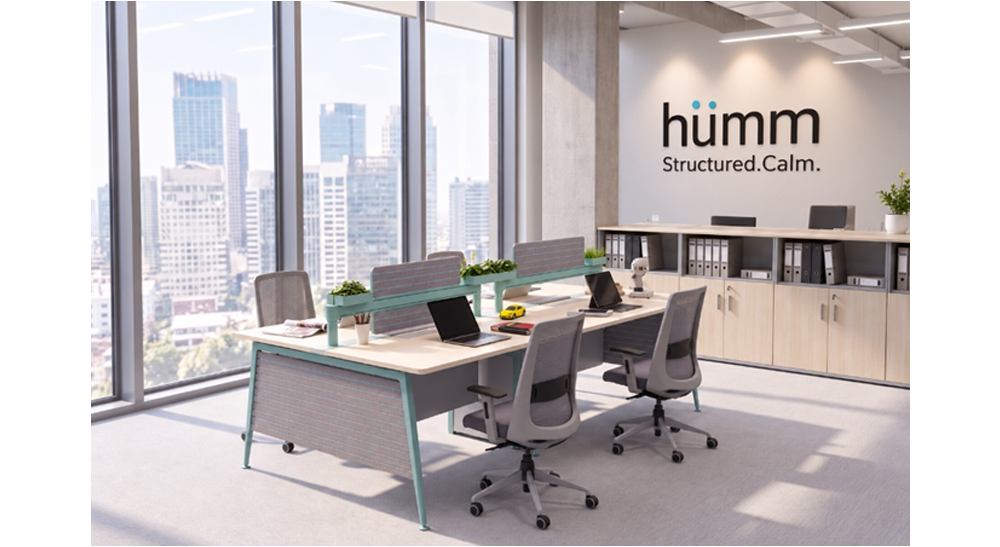
Material, height, positioning and absorption all matter. Acoustic performance cannot be understood through material ratings alone.
2. Create boundaries without building walls
Mobile screens, freestanding partitions, storage elements, high-backed furniture and other vertical surfaces can create acoustic boundaries while keeping workplaces flexible.
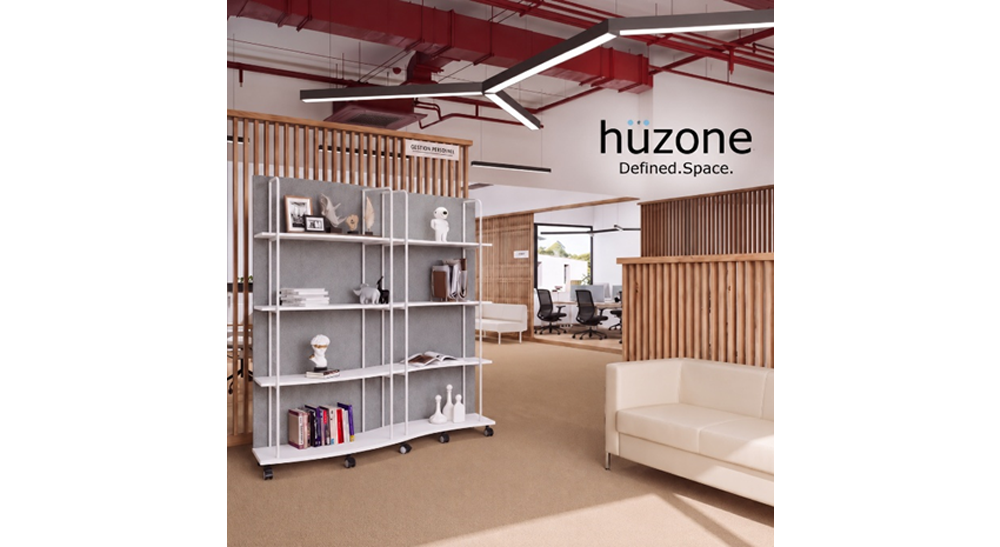
Here, ABCD becomes spatial: absorb reflections, block direct paths and use the geometry of furniture to help diffuse sound.
Furniture becomes part of the acoustic architecture.3. Build quieter places within open space
Sometimes people need more protection without complete isolation. High-backed seating, partially enclosed lounge settings and acoustic retreats can create a quieter environment inside a larger open workplace.
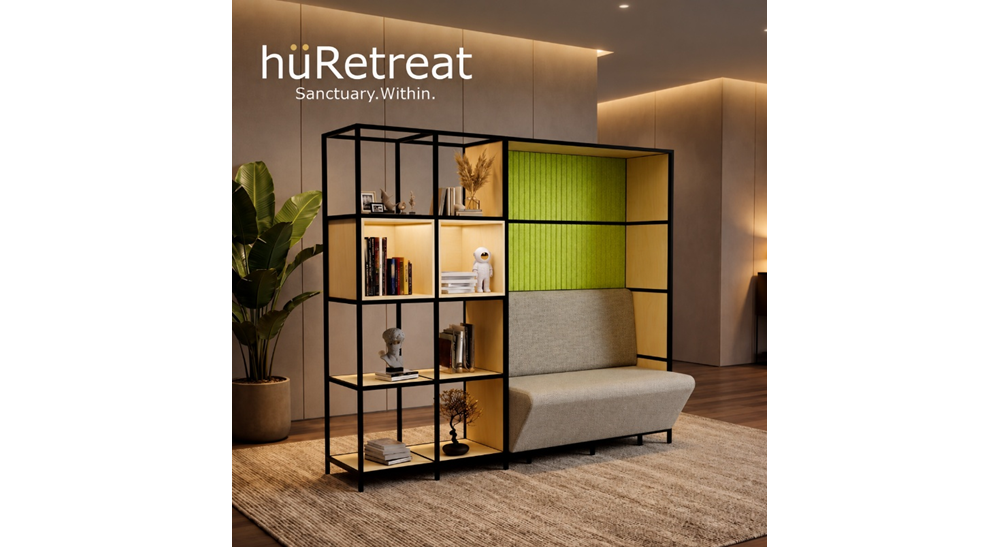
People do not always need a room. Sometimes they simply need less of the room around them.
4. Know when enclosure is necessary
There is a point at which ABCD interventions in open space are not enough. Confidential conversations, important video calls, interviews or highly focused work may require actual acoustic separation.
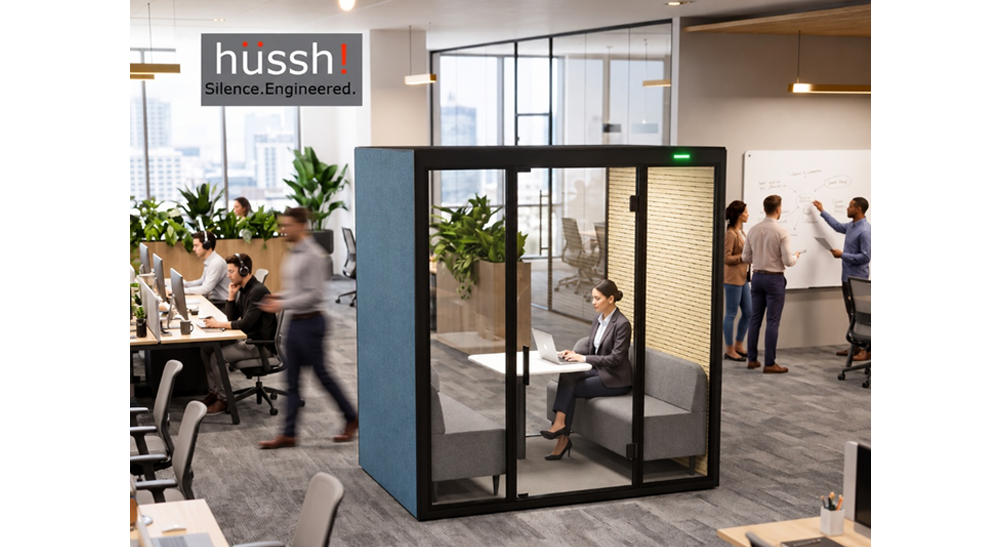
Sound absorption and sound isolation are not the same thing. They solve different problems.
Why Flexibility Matters
Offices are no longer static. Hybrid attendance changes. Teams grow and contract. Departments reorganise. Projects form and dissolve. Technology changes how people communicate.
Permanent construction has an important role, particularly where genuine acoustic isolation is required. But it cannot be the only answer.
Pods, screens, modular partitions, acoustic furniture and reconfigurable systems can allow organisations to adapt acoustic conditions without rebuilding the workplace every time working patterns change.
The objective is not to eliminate architecture. It is to give the workplace another layer of adaptability.
The best acoustic design may be the design nobody notices
Nobody walks into an office hoping to admire its reverberation time. People simply notice that they can concentrate. That conversations feel comfortable. That they can collaborate without disturbing half the floor. That there is somewhere appropriate to take a call. That a private conversation feels private.
Good acoustics becomes part of the experience of the workplace rather than something visibly applied to it.
|
CYMATICS
Sound has structure. |
ABCD
A simple language for managing sound. |
ACOUSTIC ZONING
Apply the right intervention to the activity. |
An Acoustic Ecosystem, Not a Catalogue
At Featherlite, this thinking has informed the development of the hü Collection.
The starting point was not to create a catalogue of products labelled ‘acoustic’. It was to consider the different ways sound interacts with furniture and people throughout the workplace.
At the workstation, acoustic separation can happen close to where people work. Between activities, movable and architectural elements can help establish flexible boundaries and zoning. More protected settings can create quieter environments within open space. And where genuine enclosure is required, a separate acoustic environment can support calls, conversations and focused work.
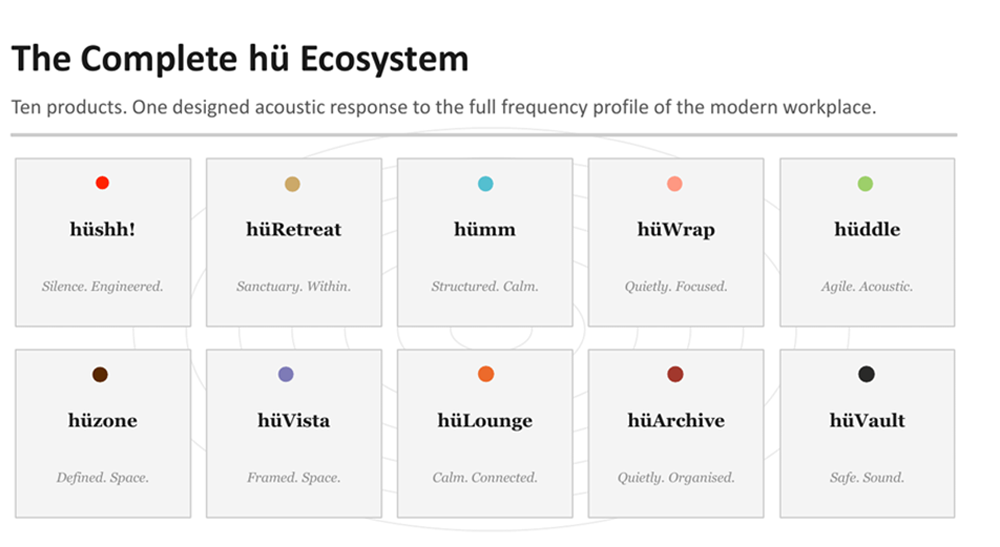
Different products. Different levels of intervention. Different work modes.
But one underlying principle: sound should be managed according to activity.
The point is not that every workplace needs every product. The point is that different acoustic problems require different combinations of intervention.
Think in Layers, Not Products
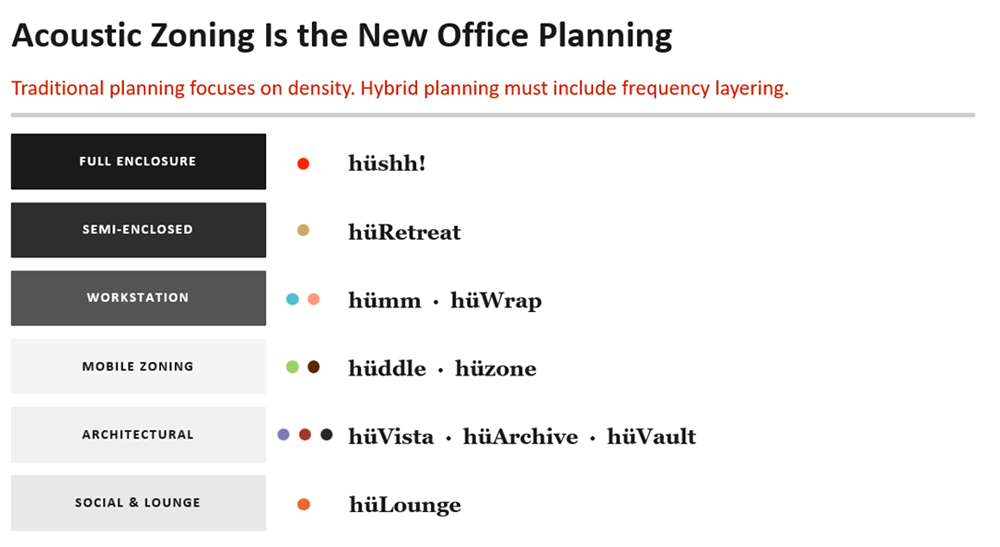
This is where the three core ideas come together:
- CYMATICS: Sound has structure.
- ABCD: A simple language for how sound can be managed.
- ACOUSTIC ZONING: Applying the right degree of intervention to the activity.
The Future Office Will Not Be Silent
More video calls mean more speech. More collaboration means more conversation. More flexible workplaces can mean fewer permanent boundaries. Trying to eliminate all that sound would defeat part of the reason people come together in the first place.
The opportunity is not to create silent offices. It is to create workplaces where sound has somewhere to go, where activities have appropriate acoustic boundaries, and where people can choose the degree of acoustic protection their work requires.
Because the best workplace is not necessarily the quietest one.
It is the one where you hear what you need to hear — and not everything else.
Sound Has Structure.
Acoustic Intelligence by Featherlite.