
Why the next generation of hybrid workplaces needs different acoustic conditions for different activities.

One workplace. Many sound environments.
Walk through a modern office on any working day.
Someone is preparing a presentation. A project team is discussing ideas. Two colleagues are catching up over coffee. A manager is conducting a video interview. Another employee is trying to finish a report before a deadline.
Every activity is legitimate. Every activity creates or responds to sound differently.
Yet in many offices, these activities are expected to coexist within essentially the same acoustic environment.
That is where the problem begins.
A conversation that encourages collaboration in one part of the office can become an unwelcome distraction just a few metres away.
The challenge is not that workplaces are noisy. It is that sound from one activity can interfere with another.
The future of workplace acoustics is not about making every space quieter. It is about creating the right acoustic conditions for the work taking place.
From understanding sound to understanding activities
In our earlier article, Sound Has Structure, we explored how sound behaves and why acoustic planning requires more than adding absorptive materials or partitions.
But understanding sound is only part of the challenge.
The next step is translating that understanding into workplace settings that support different activities.
At Featherlite, we approach this through two simple ideas: ACT and SSS.
ACT helps identify the requirement. SSS helps determine the response.
ACT: Activity. Conflict. Treatment.
Before selecting an acoustic intervention, we need to understand three things.
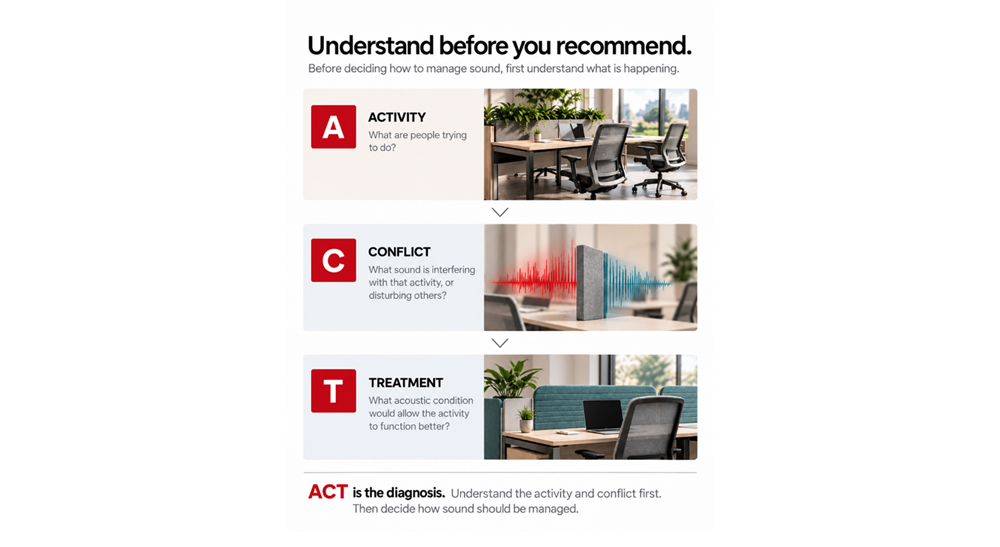
This changes the starting point of the conversation.
Instead of asking which acoustic product should be installed, we begin by understanding what people need to accomplish.
SSS: Soften. Separate. Seal.
Once the acoustic requirement is understood, the response generally involves one or more of three approaches.
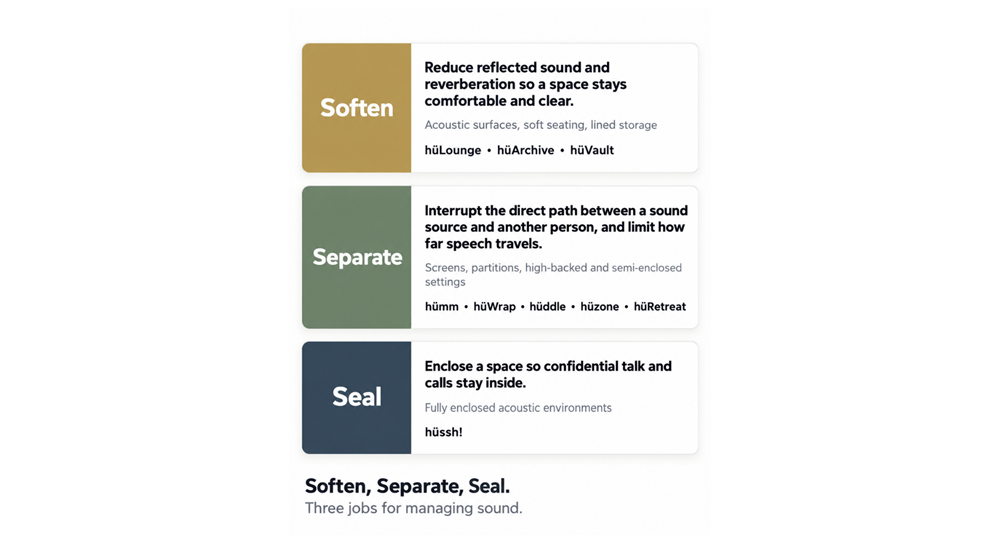
These are not three competing solutions. They are complementary interventions that can be combined according to the needs of each workplace.
The real value becomes clear when we look at how different parts of an office function.
1. The workstation: Protecting everyday concentration
The workstation remains one of the most important settings in any office.
It is where employees analyse information, prepare documents, solve problems and carry out tasks that require sustained attention.
But it is also where they are exposed to conversations from neighbouring desks, telephone calls and the general activity of the workplace.
The acoustic conflict is often not excessive volume. It is intelligible speech that repeatedly interrupts concentration.
- The activity: Individual work requiring sustained attention.
- The conflict: Nearby conversations and interruptions.
- The treatment: Reduce distracting speech while maintaining everyday interaction.
The appropriate SSS response is usually a combination of Separate and Soften.
Acoustic workstation screens can interrupt some direct sound paths and absorb reflections while retaining the openness of a shared office.
Within the hü Collection, hümm incorporates acoustic screens into the workstation, while hüWrap offers greater local separation for activities requiring deeper concentration.
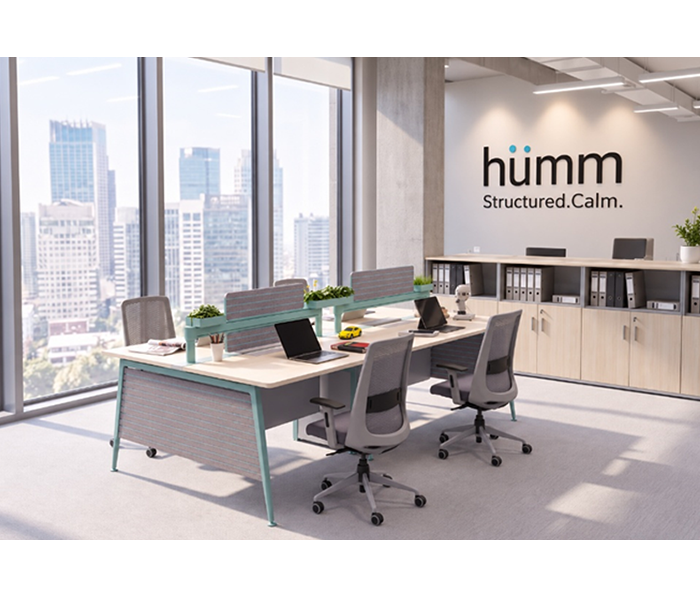
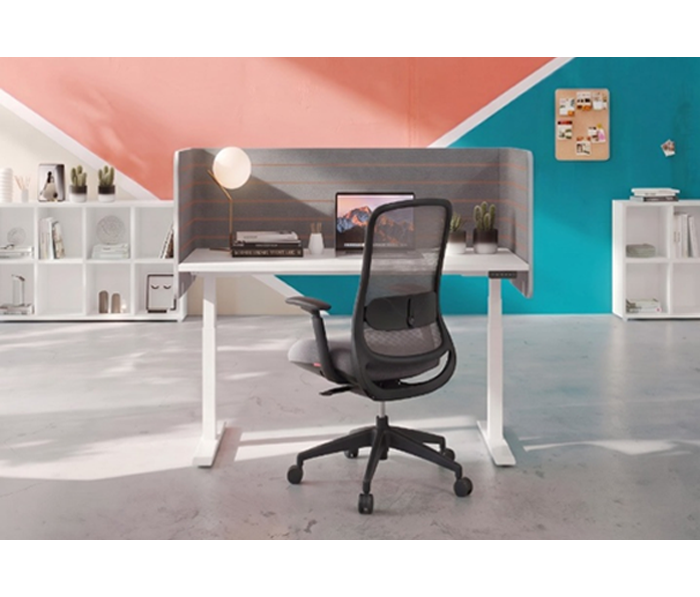
The objective is not to recreate the enclosed cubicle. It is to make an open workstation more supportive of focused work.
2. Collaboration zones: Making room for conversation
Collaboration is one of the principal reasons people come together in an office.
Teams need places to exchange ideas, review projects, solve problems and make decisions.
These activities naturally generate conversation, sometimes animated conversation.
Trying to suppress that energy would defeat the purpose of the space.
The problem arises when collaborative discussion spreads into neighbouring focus areas.
- The activity: Team discussion and collaborative work.
- The conflict: Speech spilling into neighbouring work areas.
- The treatment: Define collaborative settings without suppressing conversation.
Here, Separate and Soften work together.
Freestanding and movable acoustic boundaries can help define collaborative settings, while absorptive surfaces reduce reflected sound within them.
Featherlite’s hüddle mobile partitions allow collaborative settings to be reconfigured as teams and projects change. hüzone combines spatial separation, storage and acoustic treatment within a modular furniture system.
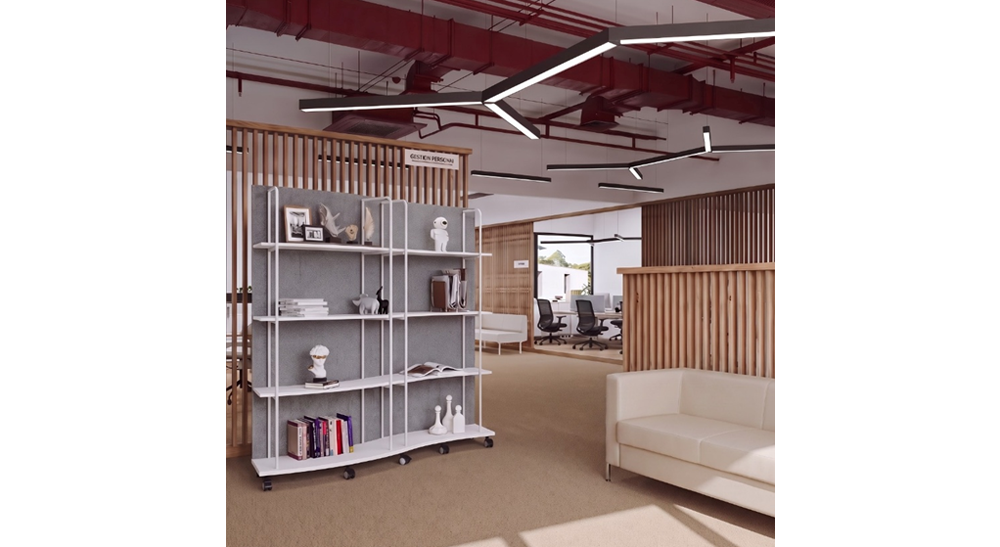
Collaboration should be encouraged within its own setting, not allowed to dominate every setting around it.
3. Social and informal zones: Keeping workplaces connected
Not every valuable workplace interaction is scheduled.
Some of the most productive exchanges happen between meetings, over coffee or during an unexpected conversation.
These informal moments help build relationships, trust and workplace culture.
But when social areas are positioned too close to concentration zones, they can become a persistent source of distraction.
- The activity: Informal conversations and social interaction.
- The conflict: Conversation disturbing adjacent focus areas.
- The treatment: Provide a comfortable setting that limits unnecessary sound spillover.
The SSS response is typically Soften and Separate.
Soft furnishings, absorptive surfaces and partially enclosed seating can help define conversational settings without making them feel isolated.
hüLounge introduces acoustic treatment into informal seating, allowing social interaction to remain part of the open workplace.
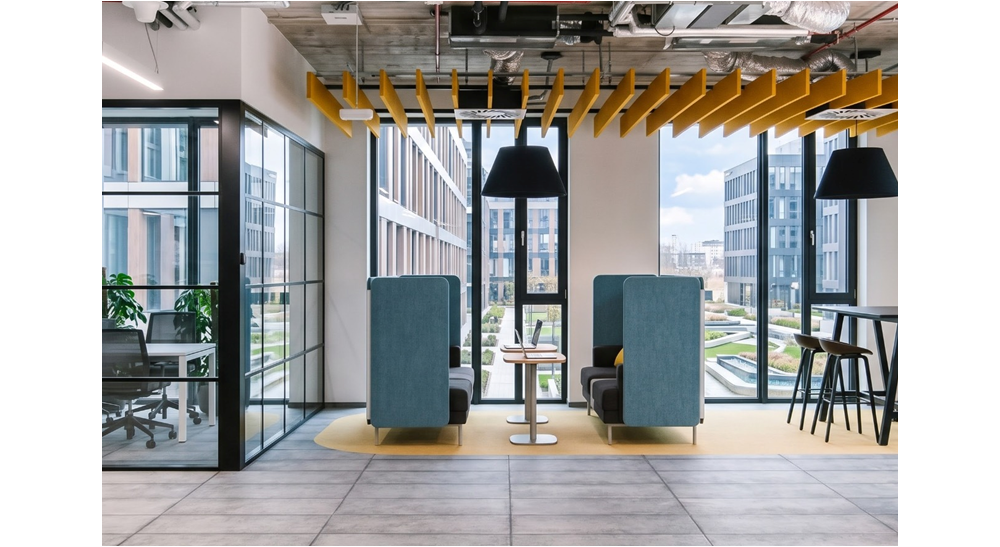
The objective is not to discourage conversation. It is to give conversation an appropriate place.
4. Retreat and deep-focus zones: Creating moments of quiet
Even within a well-planned open office, people occasionally need to withdraw from surrounding activity.
A complex report, an important decision or a demanding task may require a period of uninterrupted concentration.
Not every such requirement justifies a fully enclosed room.
- The activity: Deep concentration or temporary withdrawal from workplace activity.
- The conflict: Continuous exposure to surrounding conversations and movement.
- The treatment: Provide greater local acoustic shelter without necessarily requiring full enclosure.
Here, Soften and Separate can create an intermediate level of protection.
Semi-enclosed furniture settings can reduce exposure to surrounding activity and create a greater sense of personal separation.
hüRetreat illustrates this approach by combining seating, storage and acoustic surfaces within a partially sheltered setting.
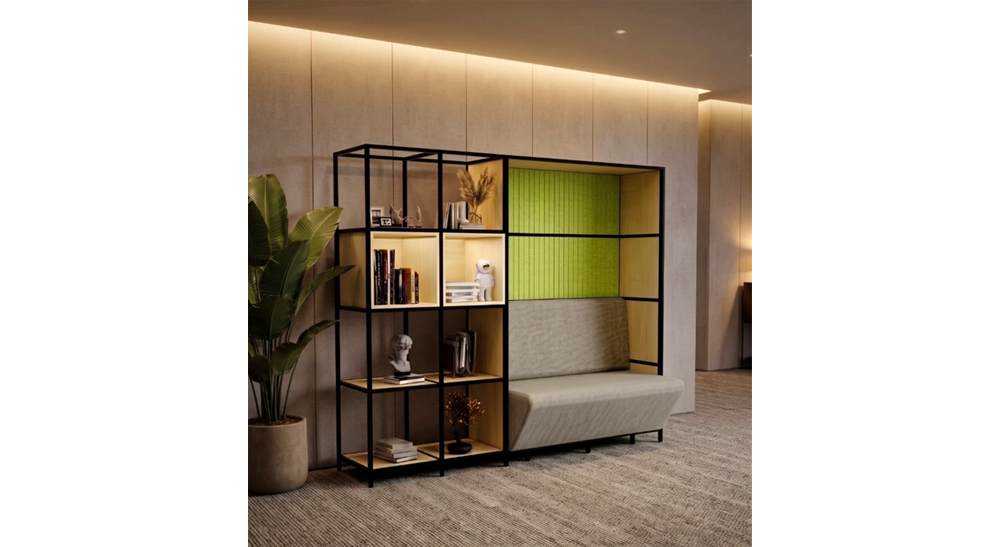
Privacy and concentration are not simply choices between an open desk and a closed room. There are useful degrees of protection in between.
5. Private calls and meetings: Knowing when to enclose
Some activities require more than partial separation.
Confidential client discussions, sensitive employee conversations, interviews and important virtual meetings often demand greater speech privacy.
An acoustic screen may reduce distraction, but it cannot provide the isolation required for every confidential conversation.
- The activity: Private calls, confidential discussions and small meetings.
- The conflict: Speech being overheard or surrounding noise interfering with communication.
- The treatment: Provide a dedicated setting with a higher level of acoustic separation.
The appropriate SSS response is Seal.
Enclosed acoustic pods and meeting environments help contain conversations and reduce the transfer of sound between the enclosed activity and the surrounding workplace.
Featherlite’s hüssh! range provides dedicated settings for individual calls and small-group meetings.
The important point is not that every office needs more pods. It is that every workplace should understand which activities genuinely require enclosure.
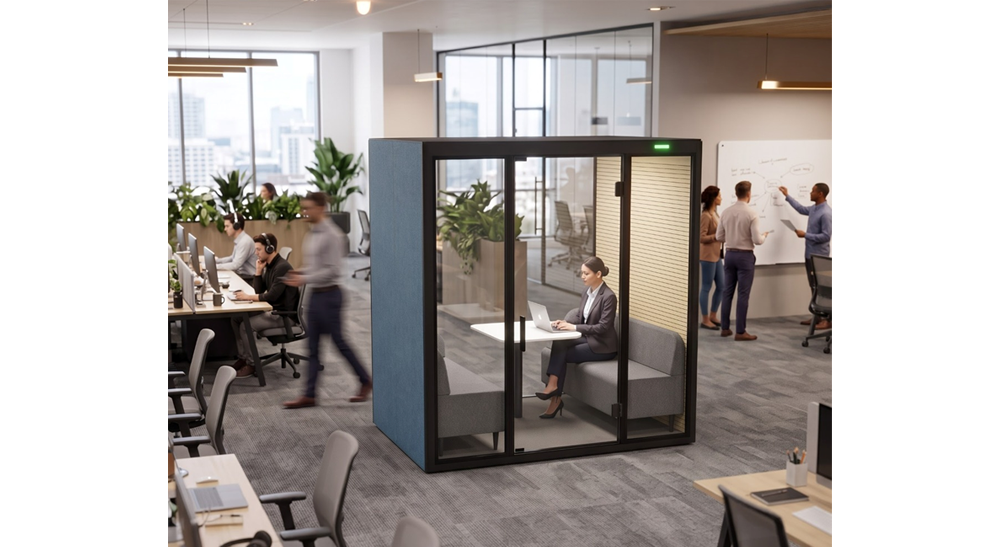
Good acoustic planning knows when to soften, when to separate and when only enclosure will do.
6. Storage and transitional zones: Making existing furniture work harder
Acoustic planning often concentrates on highly visible interventions such as screens, partitions and pods.
But furniture that already performs another function can also contribute to the sound environment.
Storage is an example.
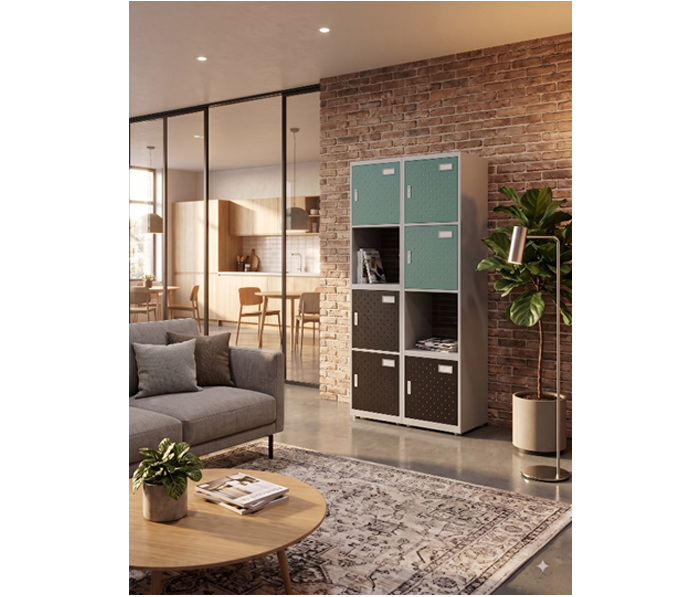
Cabinets, shelving systems and lockers occupy substantial areas of many workplaces. Their materials, placement and construction can influence how sound behaves around them.
- The activity: Storage, movement and transitions between workplace settings.
- The conflict: Reflected sound and unwanted acoustic interaction between neighbouring areas.
- The treatment: Use furniture and its placement to absorb sound and create useful boundaries.
The response can combine Soften and Separate.
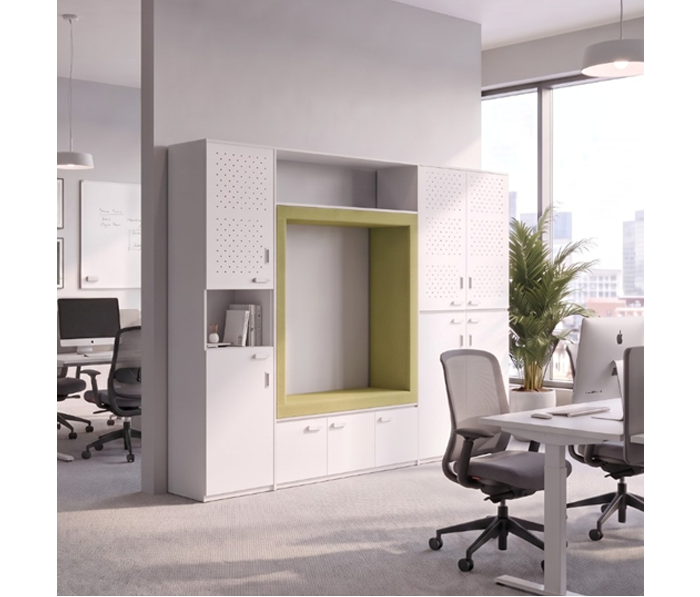
hüArchive incorporates acoustic treatment into a storage and display system, while hüVault extends this approach to personal storage.
These solutions demonstrate an important opportunity: acoustic performance can be considered alongside the everyday functions of furniture.
Rather than treating sound management as something added after the office has been furnished, it can become part of the furniture itself.
7. Acoustic zoning: Bringing the workplace together
Individually, each of these interventions addresses a particular requirement.
The greater opportunity comes from understanding how they work together.
Consider a hybrid office with focused workstations, a collaborative project area, informal seating, private call settings and storage distributed across the floor.
Each area has a different activity profile.
Each creates sound, receives sound or requires protection from sound.
The task is to understand the relationship between these activities.
A collaborative area beside a concentration zone may need more separation. A lounge near a circulation route may benefit from absorptive surfaces. Confidential calls may require enclosure, while everyday workstation conversations may need only local treatment.
This is the purpose of acoustic zoning.
It is not simply about dividing the office into quiet and noisy areas.
It is about recognising that different activities require different acoustic conditions, and arranging furniture and boundaries accordingly.
ACT helps identify the conflicts. SSS helps select the appropriate responses. Acoustic zoning brings those decisions together.

The resulting workplace uses several layers of intervention rather than expecting a single solution to perform every role.
An acoustic approach, not a collection of products
At Featherlite, this thinking informs the hü Collection.
The range addresses different requirements across the workplace, from workstation screens and movable partitions to semi-enclosed seating, acoustic storage and enclosed pods.
But the value of these products lies in how appropriately they are used.
Not every office needs every intervention.
A workplace dominated by individual analytical work will have different requirements from one centred on frequent collaboration and client interaction.
An organisation with extensive confidential discussions will need a different balance of acoustic settings from one with mostly informal teamwork.
There is no universal acoustic layout.
There is, however, a more useful starting point: understanding how people work before deciding what they need around them.
The future workplace will sound intentional
As offices continue to evolve, the challenge will not be to eliminate conversation, collaboration or social interaction.
These are essential parts of working together.
The challenge will be to allow them to coexist without one activity continually interfering with another.
That requires a shift in thinking.
- From treating noise as a problem to understanding sound as part of the workplace experience.
- From selecting isolated acoustic products to considering the relationship between activities.
- From expecting one environment to serve everyone to providing different levels of acoustic protection where they are needed.
ACT helps us understand the activity. SSS helps us determine the response. Acoustic zoning brings those decisions together.
The best workplace will not necessarily be the quietest.
It will be the one where people can concentrate, collaborate, connect and communicate—without constantly compromising one another’s ability to work.
Sound has structure. A well-considered workplace gives it direction.
Acoustic Intelligence by Featherlite
India’s workplace solution company.