
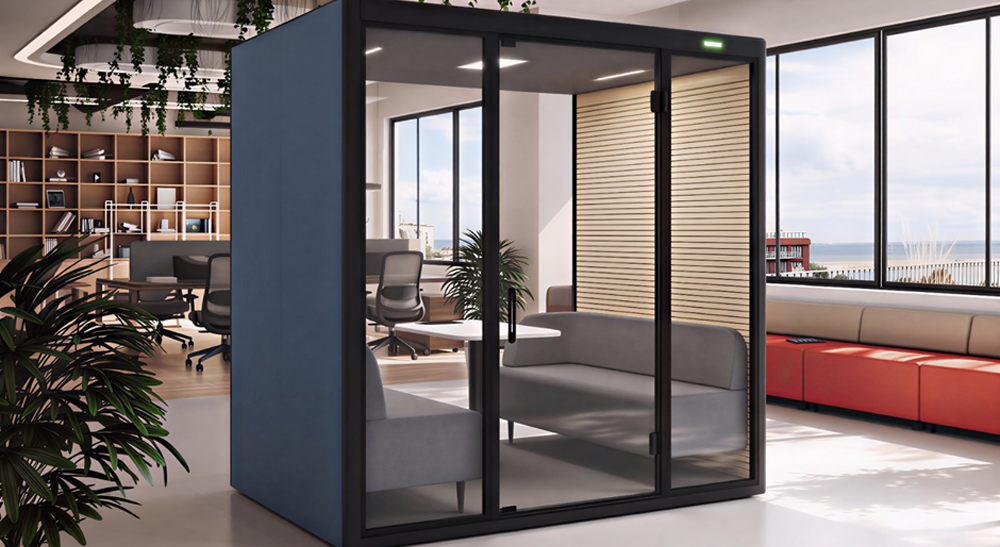
The Modern Office Has a New Challenge
The modern workplace has evolved dramatically over the past decade. Open-plan layouts, hybrid work, and collaborative environments have become the norm, replacing traditional offices filled with enclosed cabins and assigned desks.
This transformation has made offices more connected, flexible, and people-centric. However, it has also introduced a new challenge: finding the right balance between collaboration and privacy.
Employees now spend their day switching between brainstorming sessions, virtual meetings, focused work, and confidential conversations. While open workplaces encourage interaction, they often lack spaces that support concentration and uninterrupted communication.
This has led many organizations to ask an important question:
Why Traditional Meeting Rooms Are No Longer Enough
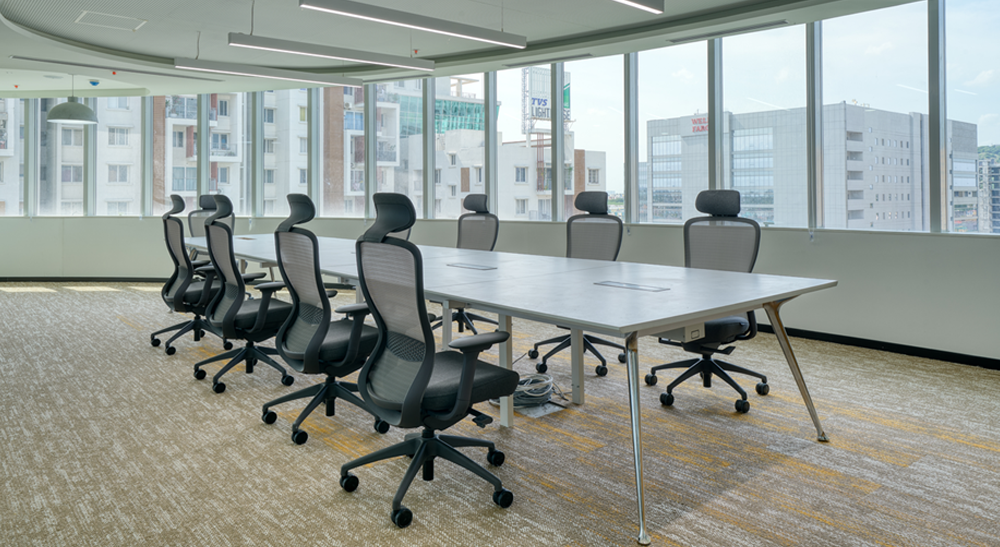
For decades, meeting rooms were the default solution for collaboration. They were designed for:
- Team discussions
- Client presentations
- Strategy meetings
- Boardroom conversations
These spaces remain essential, but the way employees use them has changed significantly.
Today, it is common to see large meeting rooms occupied by a single employee attending a virtual call. Others are booked for hours despite being used for only a fraction of that time.
This creates two major problems:
- Meeting rooms become difficult to book.
- Valuable collaborative spaces are underutilized.
The rise of hybrid work has exposed a mismatch between traditional office infrastructure and modern work patterns.
The Rise of Acoustic Pods
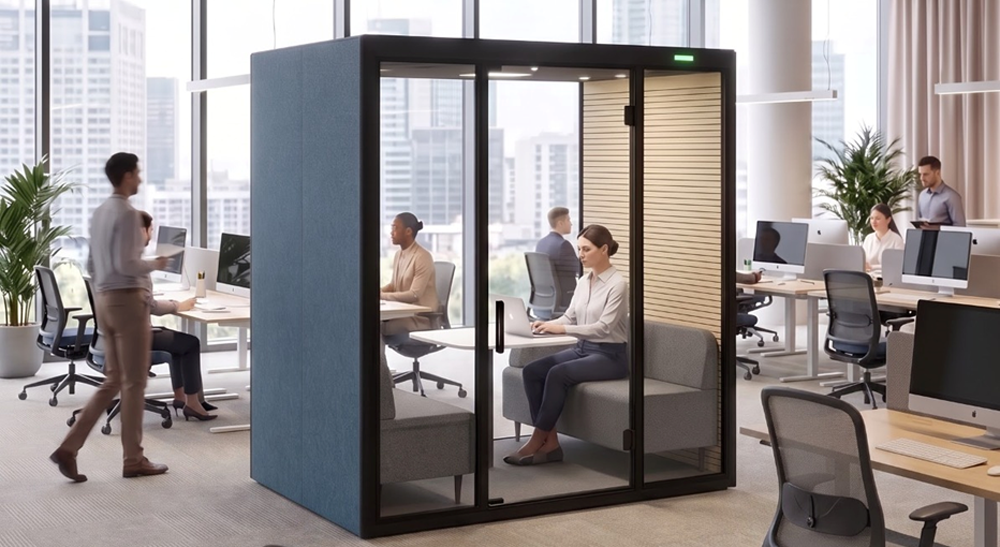
Acoustic pods have emerged as a practical solution to this challenge.
Unlike traditional meeting rooms, pods are compact, purpose-built spaces designed for focused activities such as:
- Video conferences
- One-on-one discussions
- Phone calls
- Deep work
- Confidential conversations
Instead of replacing meeting rooms, acoustic pods complement them by providing employees with spaces designed for individual or small-group interactions.
They help organizations use office space more efficiently while improving the overall workplace experience.
What “Privacy” Actually Means — Verified, Not Assumed
Most pod comparisons stop at “provides privacy.” The more useful question is how much privacy, measured against an independent standard. Featherlite’s hüssh! Pods were tested by the ARAI NVH Lab — the Automotive Research Association of India’s acoustics facility — to ISO 23351-1:2020, the international standard for speech privacy in furniture-based enclosures.

Under ISO 23351-1, Class B (25–30 dB) is the threshold for guaranteed office speech privacy, and Class A (30–33 dB) is top-tier. The hüssh! L Pod’s 30.4 dB(A) rating puts it in Class A — and its Noise Isolation Class of 35–37 dB matches the isolation of a built enclosed office (NIC ~35) or a conference room (NIC ~40), despite being a movable, relocatable pod.
Understanding the Difference
While both meeting rooms and acoustic pods provide privacy, they serve different purposes.
| Meeting Rooms | Acoustic Pods |
|---|---|
| Designed for team collaboration | Designed for focused individual or small-group work |
| Accommodate larger groups | Ideal for one to four people |
| Suitable for workshops and presentations | Ideal for video calls and confidential conversations |
| Permanent construction | Often modular and relocatable |
| Require more floor space | Compact and space-efficient |
| Higher fit-out costs | Faster to install and easier to reconfigure |
Rather than competing solutions, they address different workplace needs.
Choosing the Right Footprint for the Space — hüssh! S Pod vs L Pod
| Feature | hüssh! S Pod | hüssh! L Pod |
|---|---|---|
| Capacity | 1 person | 4 people |
| Outer footprint | 1.0 × 1.0 m | 2.2 × 1.5 m |
| Inner floor area | ~0.80 m² | ~2.94 m² |
| Speech privacy (DS,A) | 26.9 dB — Class B | 30.4 dB — Class A |
| Noise Isolation Class (NIC) | up to 32.0 dB | up to 37.0 dB |
| Ideal use | Focus work, calls, 1:1s | Team meetings, interviews, huddles |
The Hybrid Workplace Has Changed Space Utilization
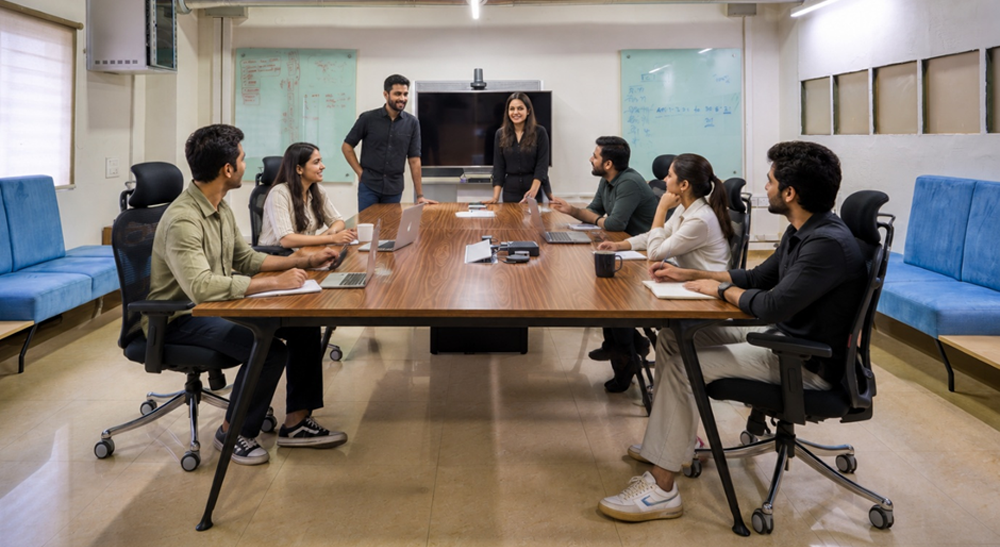
Hybrid work has fundamentally changed how offices are used. Employees now visit the workplace primarily to collaborate with colleagues, meet clients, build relationships, solve complex problems, and participate in team activities.
At the same time, they continue to spend a significant portion of their day on virtual meetings with colleagues working remotely. This means workplaces require more spaces for short, focused conversations rather than only large conference rooms.
Acoustic pods address this growing demand without increasing dependence on traditional meeting rooms.
How hüssh! Compares Against Global Pod Brands
Speech privacy figures aren’t just an internal claim — they hold up against publicly declared specifications from established international pod brands.
| Pod | Speech Level Reduction, DS,A |
|---|---|
| hüssh! S Pod (1-seat) | 27.0 dB |
| hüssh! L Pod (4-seat) | 30.4 dB |
| Framery One (1-seat) | 30.0 dB |
| Haworth HushFree (1-seat) | 30.2 dB |
| Haworth Access.L (4–6 seat) | 28.0 dB |
Sources, verified 03 Sep 2026: hüssh! Pods — ARAI NVH Lab test report, 28.07.2026. Framery One — framery.com/en/office-pods-and-booths/framery-one/tech-specs/. Haworth HushFree (S/M/L) — Haworth HushFree FAQ, haworth.com. Haworth HushFree.Access.L — Haworth technical specification sheet HUS-AP-005, haworth.com (Haworth’s own overview page separately lists 26.4 dB for this model; the model-specific spec sheet figure is used here as the more conservative, current source).
The 4-seat hüssh! L Pod delivers Class-A speech privacy — matching the single-seat flagship pods from Framery and Haworth, and outperforming Haworth’s own larger meeting pod by 2.4 dB.
The S Pod is a reliable Class-B performer, comfortably clearing the international threshold for guaranteed office speech privacy.
Disclaimer: Framery and Haworth/Hushoffice figures above are as published on their respective official websites and technical specification sheets at the time of writing (03 Sep 2026) and are subject to change without notice. Featherlite has not independently re-tested competitor products; these figures are reproduced from manufacturer-declared data for informational comparison only.
When Meeting Rooms Make Sense — and When Pods Are the Better Choice
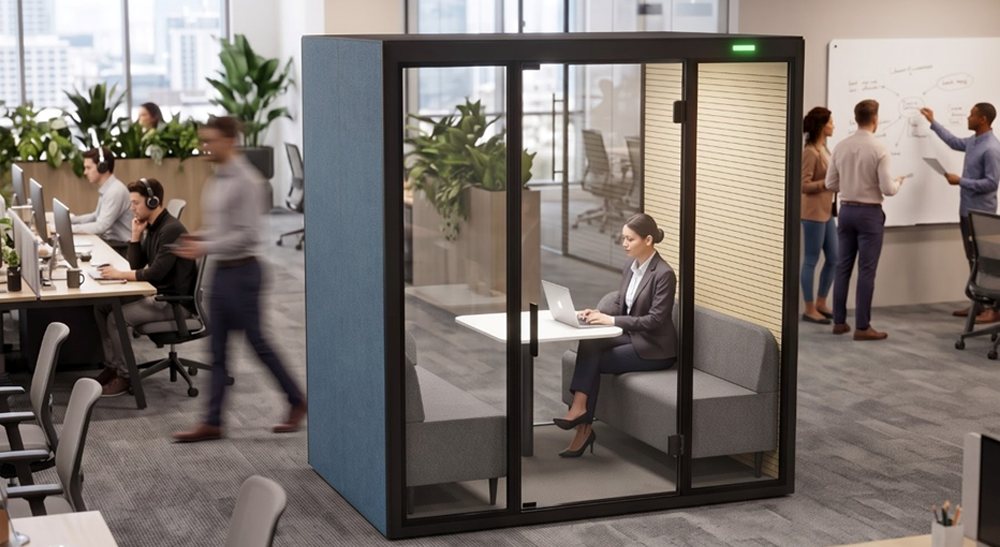
Meeting rooms remain indispensable for activities that require collaboration among multiple people: project planning sessions, workshops, client presentations, team reviews, training programs, and leadership meetings. These environments encourage discussion, idea sharing, and decision-making — replacing them entirely with pods would create limitations for larger teams.
Acoustic pods excel where privacy and focus are essential: virtual meetings, HR discussions, interviews, confidential phone calls, individual focused work, and quick one-on-one meetings.
They reduce distractions while allowing employees to step away from the open office without occupying larger meeting spaces unnecessarily.
As organizations adopt hybrid work, both sets of use cases continue to grow — which is why the smarter question isn’t which one to choose, but how to size the mix.
Backed by Independent Certification
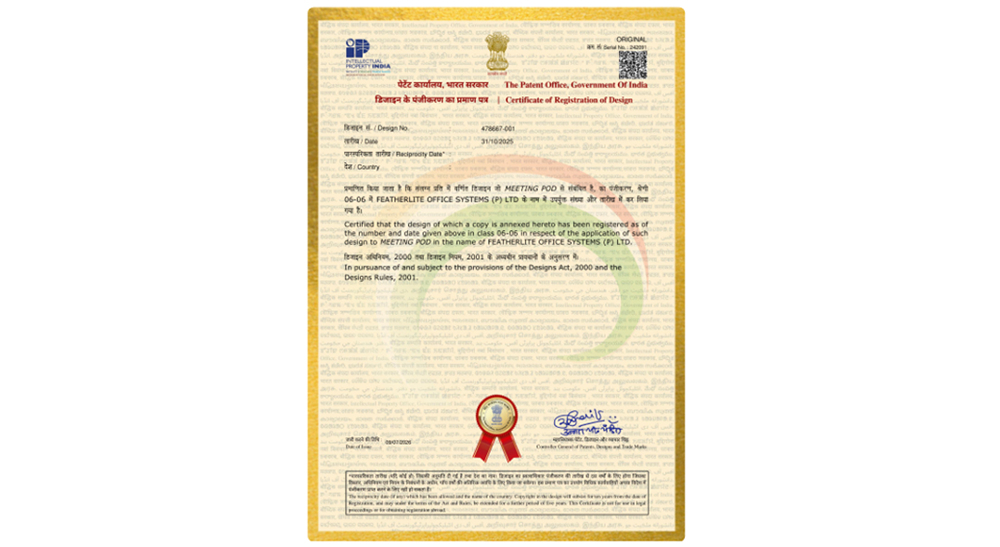
Every claim in this comparison is backed by third-party documentation, not marketing copy:
- Design-registered with the Government of India (Design No. 478667-001, Class 06-06, registered 31/10/2025) — 10 years of protection, extendable by a further 5.
- Independently tested by ARAI NVH Lab, Pune, in a 250 m³ reverberation chamber using Brüel & Kjær multi-channel data acquisition and GRAS ½” microphones.
- Standards applied: ISO 23351-1:2020 (speech level reduction), ASTM E336:2025 (noise reduction), ASTM E-413:2022 (Noise Isolation Class).
- Both S Pod and L Pod tested in both finish options (WF and PL) and in seating and standing position — full test matrix, not a single best-case number.
Full ARAI test reports are available on request as a leave-behind for RFQ, tender, and due diligence documentation.
Looking Beyond Furniture: A Workplace Strategy
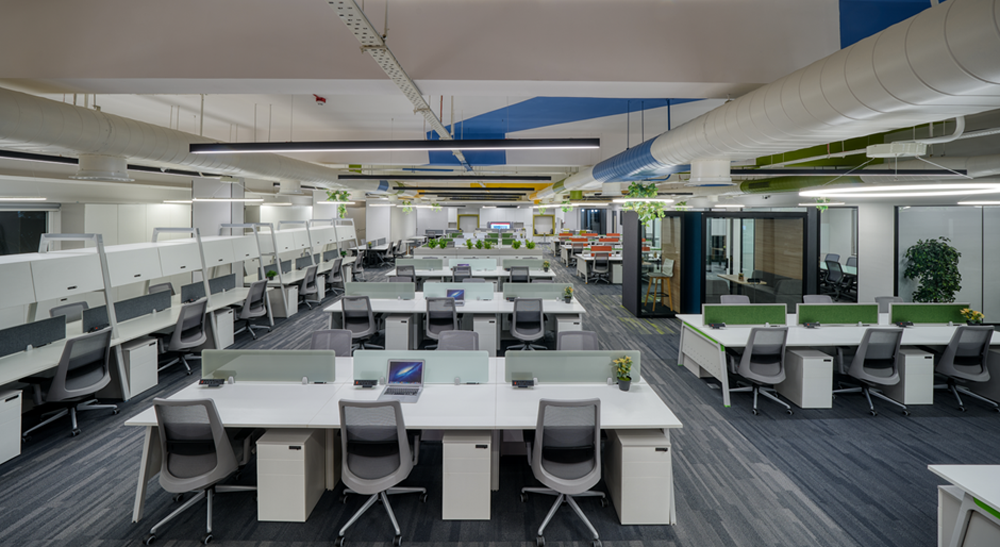
Choosing between meeting rooms and acoustic pods should not be viewed as a furniture decision. It is a workplace strategy decision.
The real question is: How do employees spend their day?
If most interactions involve small meetings, video calls, and focused work, adding more large meeting rooms may not solve the problem.
Instead, organizations should create a balanced ecosystem of spaces that supports different work modes.
This approach aligns with activity-based working principles, where employees choose the environment best suited to the task they are performing.
The Best Investment? A Balanced Workplace
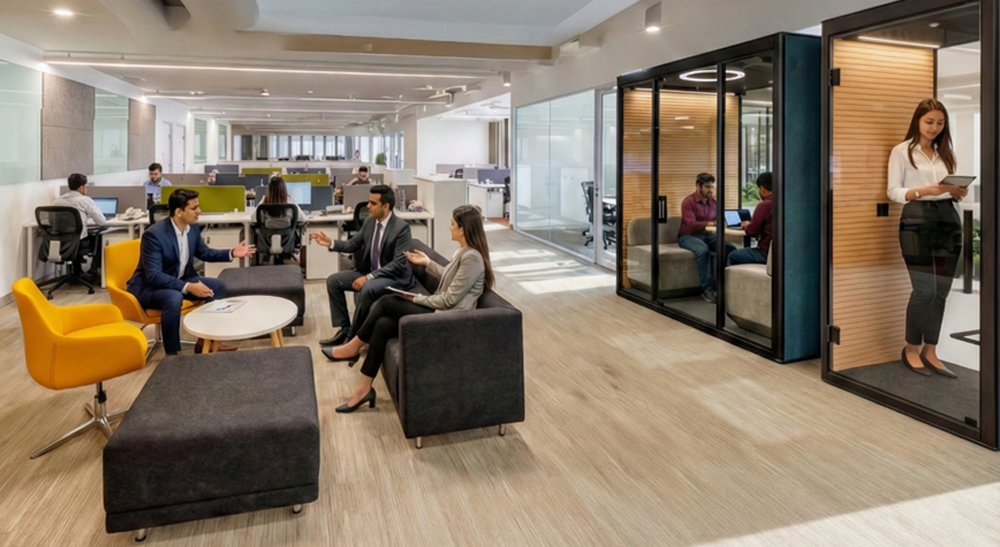
The conversation should not be acoustic pods versus meeting rooms.
It should be how both work together.
Meeting rooms remain essential for collaboration and group decision-making.
Acoustic pods provide the privacy, flexibility, and focus that today’s hybrid workforce increasingly needs.
Together, they create workplaces that are more efficient, adaptable, and employee-centric.
Our Perspective
At Featherlite, we believe successful workplaces are built around choice.
Organizations perform best when employees have access to spaces that support collaboration, concentration, and communication without compromise.
By integrating acoustic pods, modular furniture systems, collaborative settings, and ergonomic workspaces into a cohesive workplace strategy, businesses can create offices that are ready for the future of work.
As hybrid work continues to evolve, the most successful offices won’t be those with the most meeting rooms — they’ll be the ones that offer the right space for every task.